


Hola 🙂 en esta post se deja a disposición de la comunidad de programadores que quiera aprender un poquito sobre Facturación Virtual, el generador de Código de Control versión 7.0 construido según la documentación provista por Impuestos Nacionales de Bolivia (SIN).
¿Que es C#?
C# es un lenguaje de programación que se ha diseñado para compilar diversas aplicaciones que se ejecutan en .NET Framework. C# es simple, eficaz, con seguridad de tipos y orientado a objetos. Las numerosas innovaciones de C# permiten desarrollar aplicaciones rápidamente y mantener la expresividad y elegancia de los lenguajes de estilo de C.
Recordemos los algoritmos utilizados por el generador de Código de Control son:
Nuestro proyecto es el siguiente:
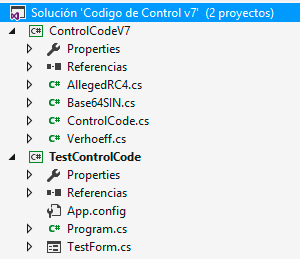
El código del generador se encuentra en el proyecto ControlCodeV7, las clases son:
AllegedRC4.cs
public static class AllegedRC4
    {
        /// <summary>
        /// Criptografia simetrica
        /// <see cref="http://jc-mouse.net/"/>
        /// <param name="message">texto a encriptar</param>
        /// <param name="key">llave para encriptacion</param>
        /// <param name="unscripted">con guion o sin guion</param>
        /// <returns>mensaje encriptado</returns>
        /// </summary>
        public static String encryptMessageRC4(String message, String key, Boolean unscripted)
        {
            int[] state = new int[256];
            int x = 0;
            int y = 0;
            int index1 = 0;
            int index2 = 0;
            int nmen;
            String messageEncryption = "";

            for (int i = 0; i <= 255; i++)
            {
                state[i] = i;
            }

            for (int i = 0; i <= 255; i++)
            {
                index2 = (((int)key[index1]) + state[i] + index2) % 256;
                int aux = state[i];
                state[i] = state[index2];
                state[index2] = aux;
                index1 = (index1 + 1) % key.Length;
            }

            for (int i = 0; i < message.Length; i++)
            {
                x = (x + 1) % 256;
                y = (state[x] + y) % 256;
                int aux = state[x];
                state[x] = state[y];
                state[y] = aux;
                nmen = ((int)message[i]) ^ state[(state[x] + state[y]) % 256];
                String nmenHex = nmen.ToString("X").ToUpper();
                messageEncryption = messageEncryption + ((unscripted)?"":"-") + ((nmenHex.Length == 1) ? ("0" + nmenHex) : nmenHex);
            }
            return (unscripted)?messageEncryption:messageEncryption.Substring(1, messageEncryption.Length-1);
        }

    }
Base64SIN.cs
public class Base64SIN
    {
        /// <summary>
        /// Codificador base64
        /// <see cref="http://jc-mouse.net/"/>
        /// <param name="value">Numero a codificar</param>
        /// <returns>Cadena codificada</returns>
        /// </summary>
        public static String convertBase64(int value)
        {
            String[] dictionary = { "0", "1", "2", "3", "4", "5", "6", "7", "8", "9",
                                "A", "B", "C", "D", "E", "F", "G", "H", "I", "J",
                                "K", "L", "M", "N", "O", "P", "Q", "R", "S", "T",
                                "U", "V", "W", "X", "Y", "Z", "a", "b", "c", "d",
                                "e", "f", "g", "h", "i", "j", "k", "l", "m", "n",
                                "o", "p", "q", "r", "s", "t", "u", "v", "w", "x",
                                "y", "z", "+", "/" };
            int quotient = 1;
            int remainder;
            String word = "";
            while (quotient > 0)
            {
                quotient = value / 64;
                remainder = value % 64;
                word = dictionary[remainder] + word;
                value = quotient;
            }
            return word;
        }
    }
Verhoeff.cs
/// <summary>
    /// For more information cf. http://en.wikipedia.org/wiki/Verhoeff_algorithm
    /// Dihedral Group stuff: http://en.wikipedia.org/wiki/Dihedral_group
    /// Dihedral Group order 10: http://mathworld.wolfram.com/DihedralGroupD5.html
    /// </summary>
    public static class Verhoeff
    {
        // The multiplication table
        static int[,] d = new int[,]
        {
            {0, 1, 2, 3, 4, 5, 6, 7, 8, 9},
            {1, 2, 3, 4, 0, 6, 7, 8, 9, 5},
            {2, 3, 4, 0, 1, 7, 8, 9, 5, 6},
            {3, 4, 0, 1, 2, 8, 9, 5, 6, 7},
            {4, 0, 1, 2, 3, 9, 5, 6, 7, 8},
            {5, 9, 8, 7, 6, 0, 4, 3, 2, 1},
            {6, 5, 9, 8, 7, 1, 0, 4, 3, 2},
            {7, 6, 5, 9, 8, 2, 1, 0, 4, 3},
            {8, 7, 6, 5, 9, 3, 2, 1, 0, 4},
            {9, 8, 7, 6, 5, 4, 3, 2, 1, 0}
        };

        // The permutation table
        static int[,] p = new int[,]
        {
            {0, 1, 2, 3, 4, 5, 6, 7, 8, 9},
            {1, 5, 7, 6, 2, 8, 3, 0, 9, 4},
            {5, 8, 0, 3, 7, 9, 6, 1, 4, 2},
            {8, 9, 1, 6, 0, 4, 3, 5, 2, 7},
            {9, 4, 5, 3, 1, 2, 6, 8, 7, 0},
            {4, 2, 8, 6, 5, 7, 3, 9, 0, 1},
            {2, 7, 9, 3, 8, 0, 6, 4, 1, 5},
            {7, 0, 4, 6, 9, 1, 3, 2, 5, 8}
        };

        // The inverse table
        static int[] inv = { 0, 4, 3, 2, 1, 5, 6, 7, 8, 9 };


        /// <summary>
        /// Validates that an entered number is Verhoeff compliant.
        /// NB: Make sure the check digit is the last one!
        /// </summary>
        /// <param name="num"></param>
        /// <returns>True if Verhoeff compliant, otherwise false</returns>
        public static bool validateVerhoeff(string num)
        {
            int c = 0;
            int[] myArray = StringToReversedIntArray(num);

            for (int i = 0; i < myArray.Length; i++)
            {
                c = d[c, p[(i % 8), myArray[i]]];
            }

            return c == 0;

        }

        /// <summary>
        /// For a given number generates a Verhoeff digit
        /// Append this check digit to num
        /// </summary>
        /// <param name="num"></param>
        /// <returns>Verhoeff check digit as string</returns>
        public static string generateVerhoeff(string num)
        {
            int c = 0;
            int[] myArray = StringToReversedIntArray(num);

            for (int i = 0; i < myArray.Length; i++)
            {
                c = d[c, p[((i + 1) % 8), myArray[i]]];
            }

            return inv[c].ToString();
        }


        /// <summary>
        /// Converts a string to a reversed integer array.
        /// </summary>
        /// <param name="num"></param>
        /// <returns>Reversed integer array</returns>
        private static int[] StringToReversedIntArray(string num)
        {
            int[] myArray = new int[num.Length];

            for (int i = 0; i < num.Length; i++)
            {
                try {
                    myArray[i] = int.Parse(num.Substring(i, 1));
                }
                catch (FormatException e) {
                    if (e.Source != null)
                        Console.WriteLine("FormatException source: {0}", e.Source);
                    throw;
                }
            }

            Array.Reverse(myArray);
            return myArray;
        }

    }
ControlCode.cs
    public static class ControlCode
    {
        /// <summary>
        /// Genera codigo de control
        /// <see cref="http://jc-mouse.net/"/>
        /// <param name="authorizationNumber">Numero de autorizacion</param>
        /// <param name="invoiceNumber">Numero de factura</param>
        /// <param name="nitci">Número de Identificación Tributaria o Carnet de Identidad</param>
        /// <param name="dateOfTransaction">fecha de transaccion de la forma AAAAMMDD</param>
        /// <param name="transactionAmount">Monto de la transacción</param>
        /// <param name="dosageKey">Llave de dosificación</param>
        /// <returns>Codigo de Control generado de la forma 6A-DC-53-05-14</returns>
        /// </summary>
        public static String generateControlCode(String authorizationNumber, String invoiceNumber, String nitci,
                           String dateOfTransaction, String transactionAmount, String dosageKey)
        {

            //redondea monto de transaccion
            transactionAmount = roundUp(transactionAmount);
            /* ========== PASO 1 ============= */
            invoiceNumber = addVerhoeffDigit(invoiceNumber, 2);
            nitci = addVerhoeffDigit(nitci, 2);
            dateOfTransaction = addVerhoeffDigit(dateOfTransaction, 2);
            transactionAmount = addVerhoeffDigit(transactionAmount, 2);
            //se suman todos los valores obtenidos
            Int64 sumOfVariables=0;
            try {
                sumOfVariables = Int64.Parse(invoiceNumber)
                                  + Int64.Parse(nitci)
                                  + Int64.Parse(dateOfTransaction)
                                  + Int64.Parse(transactionAmount);
            }
            catch (FormatException e) {
                if (e.Source != null)
                    Console.WriteLine("FormatException source: {0}", e.Source);
                throw;
            }

            //A la suma total se añade 5 digitos Verhoeff
            String sumOfVariables5Verhoeff = addVerhoeffDigit(sumOfVariables.ToString(), 5);

            /* ========== PASO 2 ============= */
            String fiveDigitsVerhoeff = sumOfVariables5Verhoeff.Substring(sumOfVariables5Verhoeff.Length - 5);
            int[] numbers = new int[5];
            for (int i = 0; i < 5; i++)
            {
                numbers[i] = Int32.Parse(fiveDigitsVerhoeff[i].ToString()) + 1;
            }

            String string1 = dosageKey.Substring(0, numbers[0]);
            String string2 = dosageKey.Substring(numbers[0], numbers[1]);
            String string3 = dosageKey.Substring(numbers[0] + numbers[1], numbers[2]);
            String string4 = dosageKey.Substring(numbers[0] + numbers[1] + numbers[2], numbers[3]);
            String string5 = dosageKey.Substring(numbers[0] + numbers[1] + numbers[2] + numbers[3], numbers[4]);

            String authorizationNumberDKey = authorizationNumber + string1;
            String invoiceNumberdKey = invoiceNumber + string2;
            String NITCIDKey = nitci + string3;
            String dateOfTransactionDKey = dateOfTransaction + string4;
            String transactionAmountDKey = transactionAmount + string5;

            /* ========== PASO 3 ============= */
            //se concatena cadenas de paso 2
            String stringDKey = authorizationNumberDKey + invoiceNumberdKey + NITCIDKey + dateOfTransactionDKey + transactionAmountDKey;
            //Llave para cifrado + 5 digitos Verhoeff generado en paso 2
            String keyForEncryption = dosageKey + fiveDigitsVerhoeff;
            //se aplica AllegedRC4
            String allegedRC4String = AllegedRC4.encryptMessageRC4(stringDKey, keyForEncryption,true);

            /* ========== PASO 4 ============= */
            //se suman valores ascii
            int totalAmount = 0;
            int sp1 = 0;
            int sp2 = 0;
            int sp3 = 0;
            int sp4 = 0;
            int sp5 = 0;
            byte[] asciiBytes = Encoding.ASCII.GetBytes(allegedRC4String);
            int tmp = 1;
            for (int i=0; i< asciiBytes.Length;i++)
            {
                totalAmount += asciiBytes[i];
                switch (tmp)
                {
                    case 1: sp1 += asciiBytes[i]; break;
                    case 2: sp2 += asciiBytes[i]; break;
                    case 3: sp3 += asciiBytes[i]; break;
                    case 4: sp4 += asciiBytes[i]; break;
                    case 5: sp5 += asciiBytes[i]; break;
                }
                tmp = (tmp < 5) ? tmp + 1 : 1;
            }

            /* ========== PASO 5 ============= */
            //suma total * sumas parciales dividido entre resultados obtenidos
            //entre el dígito Verhoeff correspondiente más 1 (paso 2)
            int tmp1 = totalAmount * sp1 / numbers[0];
            int tmp2 = totalAmount * sp2 / numbers[1];
            int tmp3 = totalAmount * sp3 / numbers[2];
            int tmp4 = totalAmount * sp4 / numbers[3];
            int tmp5 = totalAmount * sp5 / numbers[4];
            //se suman todos los resultados
            int sumProduct = tmp1 + tmp2 + tmp3 + tmp4 + tmp5;
            //se obtiene base64
            String base64SIN = Base64SIN.convertBase64(sumProduct);

            /* ========== PASO 6 ============= */
            //Aplicar el AllegedRC4 a la anterior expresión obtenida
            return AllegedRC4.encryptMessageRC4(base64SIN, String.Concat(dosageKey,fiveDigitsVerhoeff),false);
        }

        /// <summary>
        /// Añade N digitos Verhoeff a una cadena de texto
        /// <param name="value">cadena donde se añadiran digitos Verhoeff</param>
        /// <param name="max">cantidad de digitos a agregar</param>
        /// <returns>cadena original + N digitos Verhoeff</returns>
        /// </summary>
        private static String addVerhoeffDigit(String value, int max)
        {
            for (int i = 1; i <= max; i++) {
                value= String.Concat(value, Verhoeff.generateVerhoeff(value));
            }
            return value;
        }

        /// <summary>
        /// Transforma string a numero y redondea hacia arriba
        /// <param name="value">String numero de la forma 123 | 123.45 | 123,45 </param>
        /// <returns>String con el numero redondeado sin decimales</returns>
        /// </summary>
        private static String roundUp(String value)
        {
            char a = Convert.ToChar(CultureInfo.CurrentCulture.NumberFormat.NumberDecimalSeparator);
            value = (a == ',') ? value.Replace(".", ",") : (a=='.')? value.Replace(",", ".") : value;
            decimal decimalVal = System.Convert.ToDecimal(value);
            //redondea a 0 decimales
            return Math.Round(decimalVal, MidpointRounding.AwayFromZero).ToString();
        }
    }
En el proyecto TestControlCode, implementamos el código necesario para testeat los 5000 casos que nos brinda Impuestos Nacionales. Por ejemplo para 1 caso podemos hacer lo siguiente:
String code = ControlCode.generateControlCode("29040011007",
                                              "1503",
                                              "4189179011",
                                              "20070702",
                                              "2500",
                                              "9rCB7Sv4X29d)5k7N%3ab89p-3(5[A"
               );
MessageBox.Show( code );
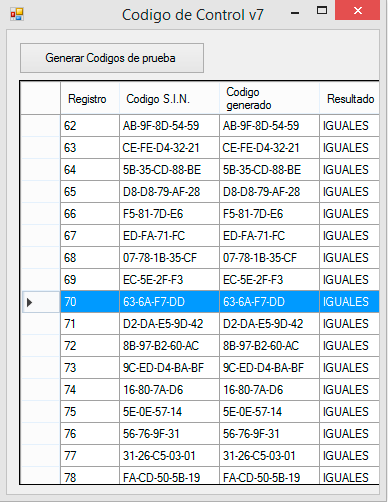
Eso es todo 🙂
Detalles de proyecto
enjoy!!!!


La Universidad Leland Stanford Junior, conocida mundialmente como la Universidad Stanford, es una universidad privada es[...]

El componente swing JLabel nos permite cargar una imagen con la propiedad setIcon, sin embargo la imagen no toma el tama[...]
En este post veremos como conectarnos a una base de datos Access con C# En un nuevo proyecto en consola con Visual Studi[...]

Cuando se desarrolla aplicaciones por lo general uno no se detiene para agregar algunos efectos visuales que pueden ser[...]

j2html es una biblioteca para java que permite generar código html seguro desde código java utilizando sus propias etiqu[...]

La autenticación basada en API keys es un método para proteger el acceso a una API. Se utiliza una clave alfanumérica ún[...]

